Banji Olatomirin

HR, recruitment design, and responsible AI

I work where HR and AI meet.

I build practical systems for better hiring and workforce decisions, while keeping accountability with the people responsible for them.

I've spent twelve years in HR, from front-line recruitment to advising senior leaders through organizational change. I build recruitment systems, succession pipelines, labour-market writing, and AI tools that make work more consistent without handing judgment away.

“Integrity is doing it properly, even when no one's watching.”

MBA, CPHR, ACIPM. Over a decade in HR. Calgary, Alberta.

Independent work

Built on my own time, so I can show it in full. Where I cite a figure, it's labeled measured or estimated.

Independent

The Alberta Labour Market Brief

My contribution
Created a monthly LinkedIn brief translating Statistics Canada's Labour Force Survey into an Alberta-specific, plain-language read.
Outcome
Publishing consistently since October 2025; HR leaders and job seekers get a regular, data-backed view of Alberta's job market.
Problem
Most people trying to make sense of Alberta's job market are stuck choosing between two bad options: dry government data written for economists, or LinkedIn hot takes with no numbers behind them.
Challenge
Statistics Canada puts out the real data every month, but it's built for analysts, not for someone deciding whether now's a good time to hire, switch jobs, or ask for a raise. Someone has to translate it without watering it down.
What I built
A monthly brief, published on LinkedIn, that turns Statistics Canada's Labour Force Survey into something people can actually use: plain numbers, straight talk, and infographics that show the story at a glance.
Why
Because I was tired of seeing labour market content that's either too technical to use or too vague to trust. I wanted something that just tells people what's happening, straight, with the data to back it up.
Key Benefit and Result
HR leaders and job seekers get an honest, Alberta-specific read on the job market every month, built on real Statistics Canada numbers, not guesses. Publishing consistently since October 2025.
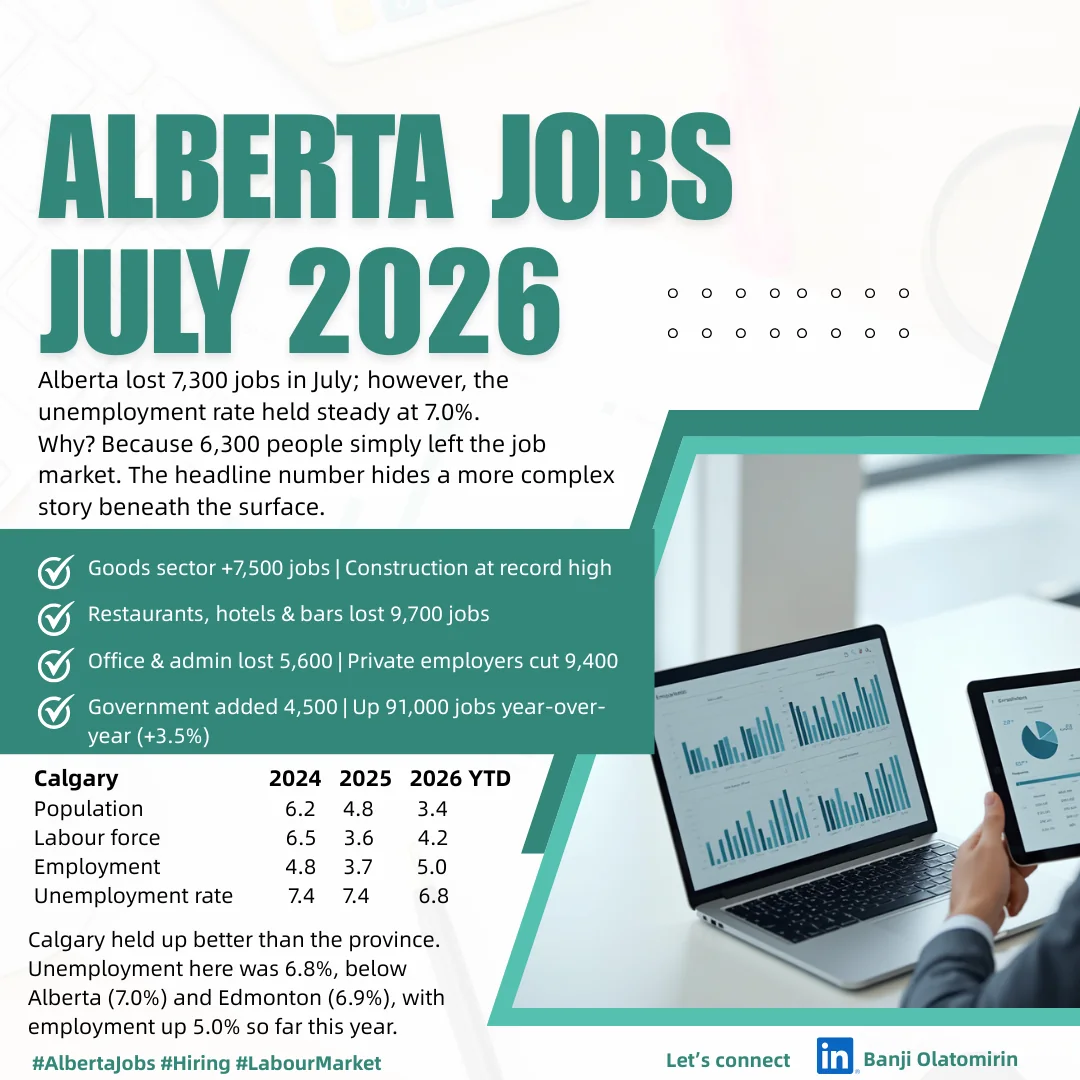
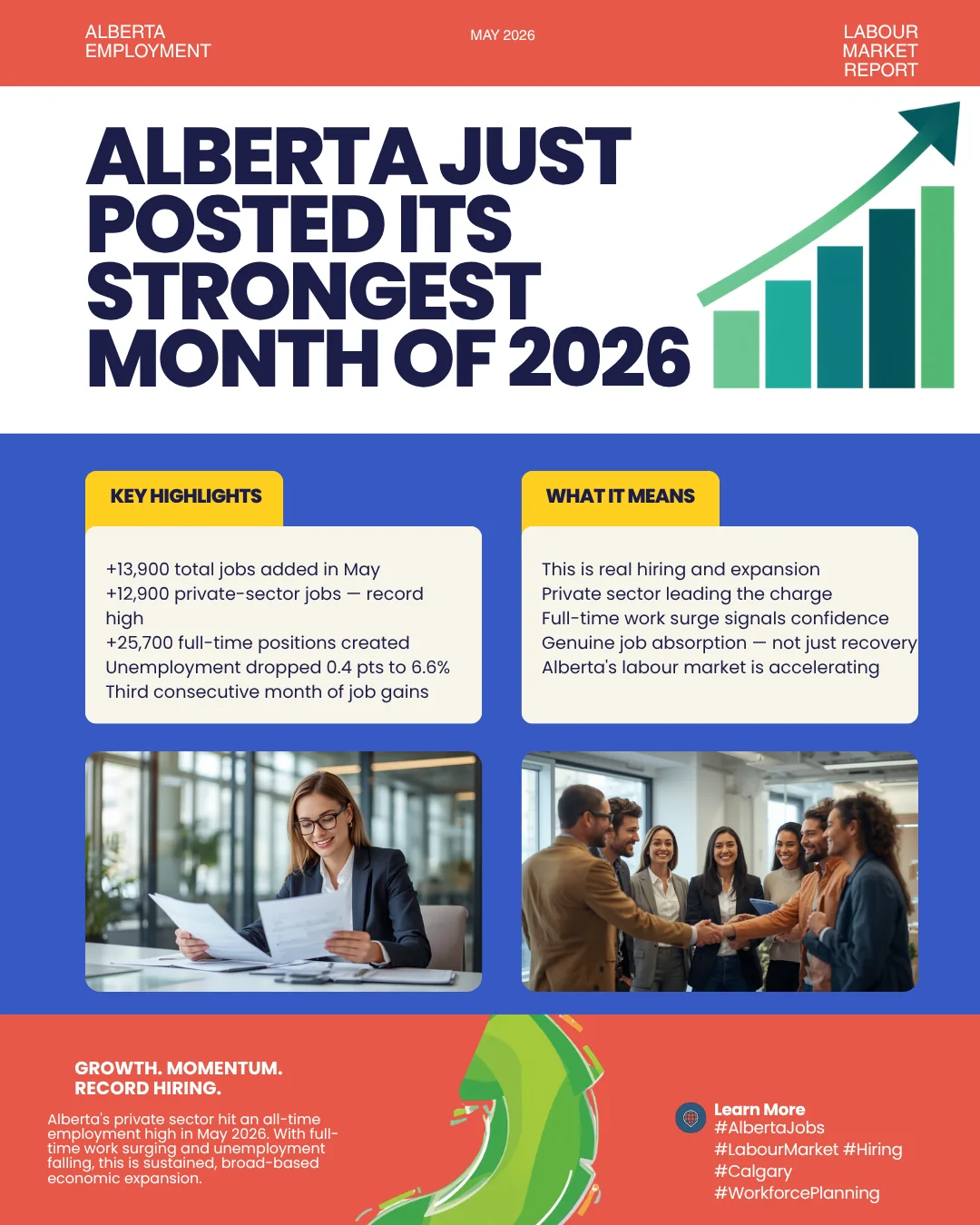
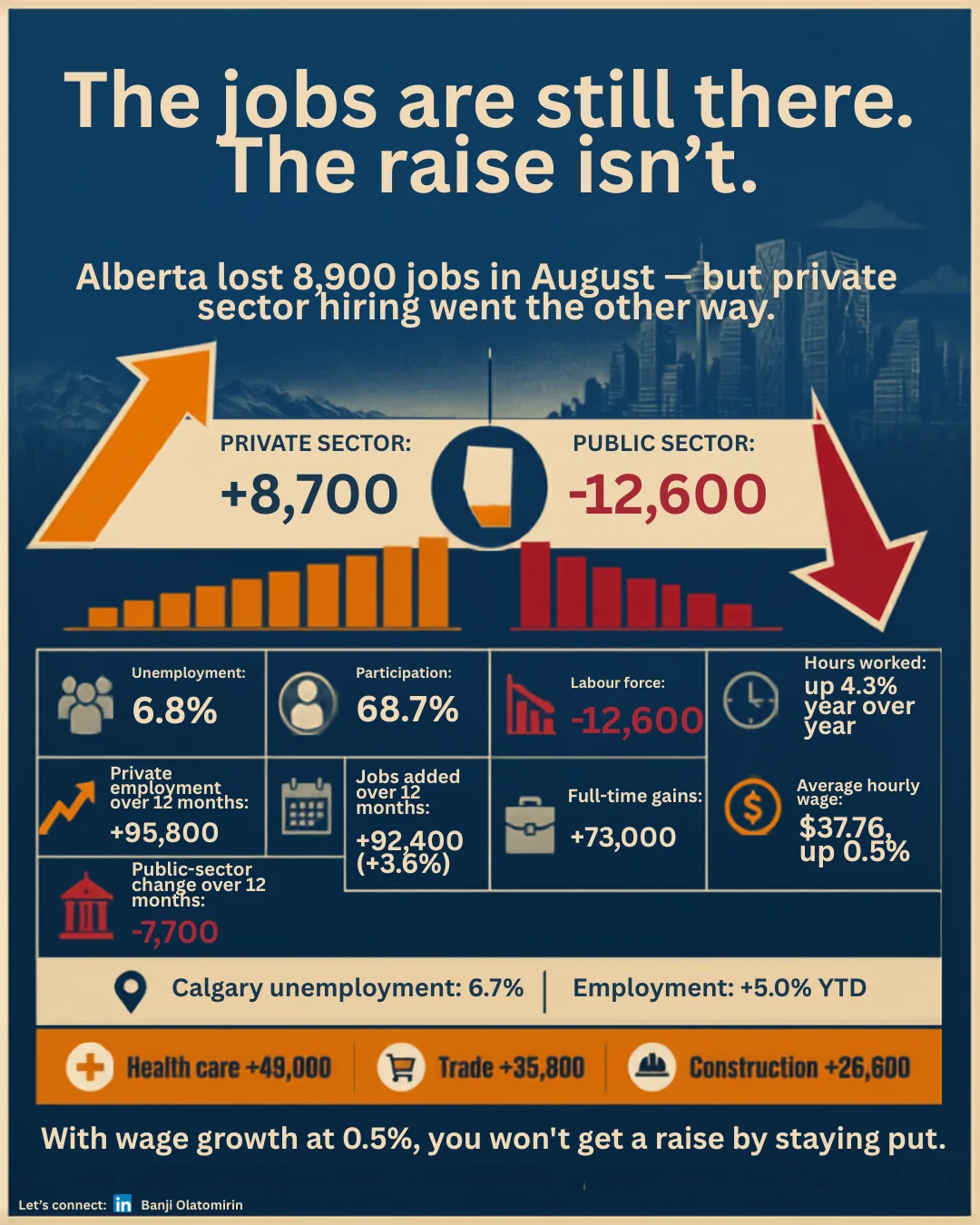
August 2026 issue: Alberta lost 8,900 jobs, with private-sector employment up 8,700 and public-sector employment down 12,600. Unemployment 6.8%, average hourly wage $37.76, up 0.5%. July 2026 issue: Alberta lost 7,300 jobs while unemployment held at 7.0%, as 6,300 people left the labour force. Calgary unemployment was 6.8%. May 2026 issue: Alberta added 13,900 jobs, including 12,900 in the private sector, and unemployment fell to 6.6%.
The August, July and May 2026 issues. Tap one to see it full size. Follow the Brief on LinkedIn

Independent

Prompt Forge

My contribution
Built a platform-aware prompt engineering system with a proposed structure, user confirmation, and source citations.
Outcome
Version 2 has been audited and revised with eight changes, each traced to a real source.
Problem
When working with AI, a plain description of what you want rarely turns into an output that you intend and that actually works. And what works for Claude doesn't work for Copilot, and what works for Copilot doesn't work for Midjourney. Everyone ends up rewriting the same idea three different ways, by trial and error.
Challenge
Build something that does that translation properly, without turning into one of those bloated multi-step AI pipelines that are slow, expensive, and hard to trust. One prompt, one call. No self-consistency chains, no Tree of Thoughts, no ReAct loops. Every line has to earn its place.
What I built
A prompt engineering system that takes any task and optimizes it for the AI platform running it. Every prompt gets the same disciplined structure: role, context, reasoning, constraints, format, with source material placed last. It proposes the structure first and waits for a yes before it writes anything, and it cites what it's relying on instead of guessing.
Why
Prompt engineering is the difference between AI that does what you meant and AI that does what you typed. Most people never close that gap. I wanted a system that closes it every time, on any platform, without me having to relearn the same lesson for each one.
Key Benefit and Result
Better AI output, consistently, on whatever platform the work calls for, because the prompt behind it was engineered instead of guessed at. Now on version 2, audited and revised with eight changes, each one traced back to a real source.

A plain task

Draft a screening rubric for a policy analyst posting.

What Forge returns, section by section

Role
Who the model is for this task
Context
The situation, audience and purpose
Reasoning
How to work through the problem
Constraints
What it must and must not do
Format
What the output looks like
Source material
In XML tags, placed last
How Prompt Forge structures a prompt from a plain task.

Employer Work

Work for paid employment, described at the level of method. Every example uses made-up data. No personal information appears on this site.

Employer Work

Resume screening agent

My contribution
Developed a nine-version screening agent that grounds ratings in verbatim experience and keeps a person in the review loop.
Outcome
Validation against past competitions using the applicant tracking system as a benchmark held up across almost all of them.
Problem
High-volume hiring competitions get hundreds of applications, and screening all of them by hand is slow, inconsistent, and hard to defend later. Every reviewer reads a little differently, and there's rarely a clear record of why one candidate moved forward and another didn't.
Challenge
Build an AI agent that could screen at that volume without cutting corners on fairness, and without touching any real candidate data on a platform that wasn't approved for it. Every rating had to trace back to something real, not a vibe.
What I built
A screening agent, refined through nine versions, that rates every application against a verbatim line from the candidate's actual experience, under a named employer or job title. No credit for a well-written summary with nothing behind it. A person reviews every single assessment before anything moves forward.
Why
Because a rating nobody can explain isn't a rating, it's a guess with a number attached. I built the agent so the rules that protect fairness stay fixed no matter what, while the details that change from one competition to the next, like minimum requirements or ranking criteria, get set separately, so they never quietly override the fairness rules underneath.
Key Benefit and Result
Faster screening at volume, with every decision traceable and a person still making the final call. Validated against real past competitions using the applicant tracking system as the benchmark, it held up across almost all of them. The one exception came down to how that particular competition was run, not a flaw in the agent.

Decision record

Illustrative, made-up data

Criterion
Stakeholder engagement
Evidence
A verbatim line, located under a named job title
AI's part
Drafts a rating and a written rationale
Person's part
Reads the rationale. Accepts it or overrides it.

Employer Work

The Recruitment Brief

My contribution
Built a single labeled recruitment brief that generates the job ad, screening rubric, and interview guide.
Outcome
Competition documents trace back to one source, keeping what the job ad promises aligned with what interviews assess.
Problem
Every hiring competition needs a job ad, a screening rubric, and an interview guide, and they're supposed to all describe the same role. In practice they often don't, because each one gets written separately, sometimes by different people, at different points in the process.
Challenge
Get every document in a competition to actually agree with each other, without adding another manual step that people skip when they're busy.
What I built
A system that compiles a strategic recruitment plan into one labeled brief, then generates the job ad, screening rubric, and interview guide from that single source. Nothing gets rewritten from scratch three times. It all comes from the same place.
Why
Because a mismatch between the job ad and the interview guide isn't just sloppy, it's unfair to candidates and it makes the whole process harder to defend. One source fixes that at the root instead of catching it after the fact.
Key Benefit and Result
Every document in a competition now traces back to the same brief, so what's promised in the job ad is what actually gets assessed in the interview. Less rework, more consistency, and a process that holds together end to end.
Strategic Recruitment Plan workbook
Recruitment BriefCompiled once, labeled
Job ad
Screening rubric
Interview guide
One compiled brief feeds every document in the competition.

Employer Work

Hiring Manager Auto Updates

My contribution
Built a scheduled agent that uses the requisition tracker to email hiring managers status updates.
Outcome
Managers stay informed automatically while recruiters spend less time responding to update requests.
Problem
Hiring managers want to know where their competition stands, and recruiters end up fielding the same "any update?" questions over and over, on top of everything else on their plate.
Challenge
Give hiring managers real visibility into their competition's status without turning it into another manual task someone has to remember to do.
What I built
A scheduled agent that pulls from the requisition tracker and emails hiring managers a status update automatically, so they always know where things stand without having to ask.
Why
Because a hiring manager left in the dark starts chasing updates, and every one of those check-ins pulls a recruiter away from actually moving the competition forward. Automating the update removes the back-and-forth for both sides.
Key Benefit and Result
Hiring managers stay informed without lifting a finger, and recruiters get their time back. One less thing to track, one less thing to be asked about.

Employer Work

AI Training

My contribution
Led hands-on sessions showing colleagues real AI-assisted workflows relevant to their day-to-day work.
Outcome
Colleagues can use AI-assisted workflows confidently in their own work, not only watch a demonstration.
Problem
Rolling out an AI tool doesn't help anyone if the people meant to use it don't know how, or don't trust it enough to bother.
Challenge
Get a team of colleagues comfortable with AI-assisted workflows, not just shown a demo once and left to figure out the rest on their own.
What I built
Hands-on training sessions that walked colleagues through real AI-assisted workflows, the kind they'd actually use day to day, not a generic overview.
Why
Because a tool nobody adopts is a tool that wasted everyone's time building it. Training closes the gap between having access to AI and actually getting value from it.
Key Benefit and Result
Colleagues who can use AI-assisted workflows confidently in their own work, not just watch someone else use it.

Employer Work

The Shadow Board (A Succession Planning Program)

My contribution
Designed the Shadow Board, giving 8–10 managers real strategic work and a seat at actual board meetings.
Outcome
Executive time-to-fill fell from six months to six weeks; three of four Director roles had 2+ ready successors, with 95% participant retention.
Problem
Executive roles were taking six months to fill, and eight Director-level positions carried real key-person risk. If any one of those people left, there was no one ready to step in, and turnover across the wider organization was already accelerating.
Challenge
Build a succession pipeline for an organization of over 600 people, one that produced people who were genuinely ready, not just names on a list.
What I built
The Shadow Board: a rotating group of 8 to 10 high-potential mid-level managers, given real strategic problems to solve and a seat at actual board meetings, not simulations. They worked through the same decisions the organization's leadership was working through, in real time.
Why
Because readiness isn't something you can test for in an interview. It's something people build by doing the job before they officially have it. Giving people real problems and a real seat at the table was the only way to know, honestly, who was ready to step up when a Director role opened.
Key Benefit and Result
Executive time-to-fill dropped from six months to six weeks. Three out of four Director roles ended up with two or more people ready to step in immediately, and participants in the program stayed at a 95% retention rate.
Real work created a visible, tested succession pipeline—not a list of possible names.

Employer Work

Workforce Planning Project

My contribution
Built a role-segmentation model, 2027 gap projection, and a four-part workforce response across build, buy, borrow, and bridge.
Outcome
Leadership funded internal upskilling to protect delivery of a critical technology project during the projected shortage period.
Problem
A wave of clinical talent was leaving for opportunities abroad, and a critical technology project needed high-end technical skills that were being aggressively recruited away just as fast. Meanwhile, rising inflation was making fixed annual salary reviews useless as a retention tool. Three pressures hitting at once, and no single fix for any of them.
Challenge
Figure out where the organization would actually break, not where it felt like it might, across 600+ roles, and make the case for a response before the shortage became a crisis instead of a forecast.
What I built
A workforce segmentation model that sorted every role by value and scarcity, and a projection of where the biggest gaps would land by 2027. The numbers were stark: a shortfall of 17 technical specialists and 16 medical officers, both flagged critical. From there, I built a four-part response: build internal talent through structured programs, buy external talent through a fellowship, borrow contingent talent from former staff now working abroad, and bridge the gap by retraining clinical staff into hybrid data and clinical roles.
Why
Because you can't hire your way out of a 17-person shortage in a specialized field, not when everyone else is short too. The only way to close a gap like that is to grow the people already inside the organization faster than the ones leaving.
Key Benefit and Result
A funded, board-level response, not just a warning. Leadership backed the internal upskilling investment, protecting delivery of a critical technology project during the exact period the shortage was projected to hit hardest.

My Work Philosophy

Integrity
I operate the same way regardless of who is watching. Every claim I make has to be defensible, and if something cannot be substantiated, I say so rather than presenting it with more certainty than it deserves. Integrity is not a stated value here. It is the standard that governs how decisions actually get made.
Artificial Intelligence
I treat AI as an instrument for speed and consistency, not for judgment. It has real value in reducing repetitive work and improving reliability at scale. But any decision that affects someone's livelihood remains with a person, with clear accountability for who made that decision and why. Using AI responsibly means understanding precisely where its usefulness ends and human responsibility begins, and never allowing that line to blur for the sake of convenience.
Relationship Building
Effective work depends on trust, and trust is not preserved by managing information quietly. When something is unresolved or still under discussion, I say so directly, with clear ownership of who is responsible for resolving it. People can work well with uncertainty. What undermines a working relationship is being left uninformed. Directness, even when the answer is that something is not yet decided, is what sustains the kind of trust real collaboration requires.
Business Oriented
Process has value only insofar as it produces results. Every decision I make is weighed against its actual impact on the organization, not simply whether it appears rigorous or well-considered. I hold rigor and outcomes to the same standard, because done well, they are not competing priorities. They are the same objective.

Blogs & Articles

Writing on labour markets, recruitment design, responsible AI in HR, and evidence-led workforce decisions.

Background

Now
Talent Acquisition Consultant, Public Service Commission, Government of Alberta, since 2022Client: Treasury Board and Finance
Before
Senior HR Business Partner, APIN Public Health Initiatives, Abuja, 2019 to 2021HR Business Partner, APIN Public Health Initiatives, 2014 to 2019
Designations
CPHR, ACIPM
Education
MBA, Human Resources Management, Ahmadu Bello University, 2019B.Tech, Fisheries and Wildlife, Federal University of Technology, Akure, 2012
Analytics
Certified HR Reporting Specialist (AIHR)Google Data Analytics CertificateAnalyzing and Visualizing Data with Power BI (Microsoft)Machine Learning Foundations 1 (Amii)
Also
Independent labour market analyst and author of the Alberta Labour Market Brief, since 2025Co-founder of Neon Crest, a creative production studio in Calgary

Get in touch

Email is the fastest way to reach me. I'm glad to talk about recruitment design, AI in HR, public sector hiring, or the Brief.